Mzansi Tea House is the shop of Abdulla and Aaliyah, two founders who sell specialty loose-leaf tea from Parkwood, Johannesburg, and connect it to tea communities elsewhere. Aaliyah grew up in the city on daily masala chai; Abdulla grew up in Sharjah on Palestinian sage tea and Gulf karak, and has published an academic paper on the latter. There is no walk-in counter: tea is bought online for collection in Parkwood or delivery, and the house is visited for a private tasting booked by email, one to six people at a time, two hours long, with teas and teaware for sale at the end of the session.
The shelf is small and chosen by origin. The black teas are ancient-tree Vietnamese lots from Hà Giang, Lào Cai and Yên Bái, sold in 25 or 30 g with picking date and elevation on the page, beside a Yunnan Dian Hong. The oolongs are Fujian and Guangdong: a Wuyi Da Hong Pao, a Phoenix Mountain Ya Shi Xiang dan cong, a Zhang Ping Shui Xian pressed into two 9 g bricks, and two roasted Tie Guan Yin scented with osmanthus or gardenia. White tea is a Yunnan Silver Needle and a Fujian Gong Mei; the dark shelf runs from a Guangxi Liu Bao to puerh.
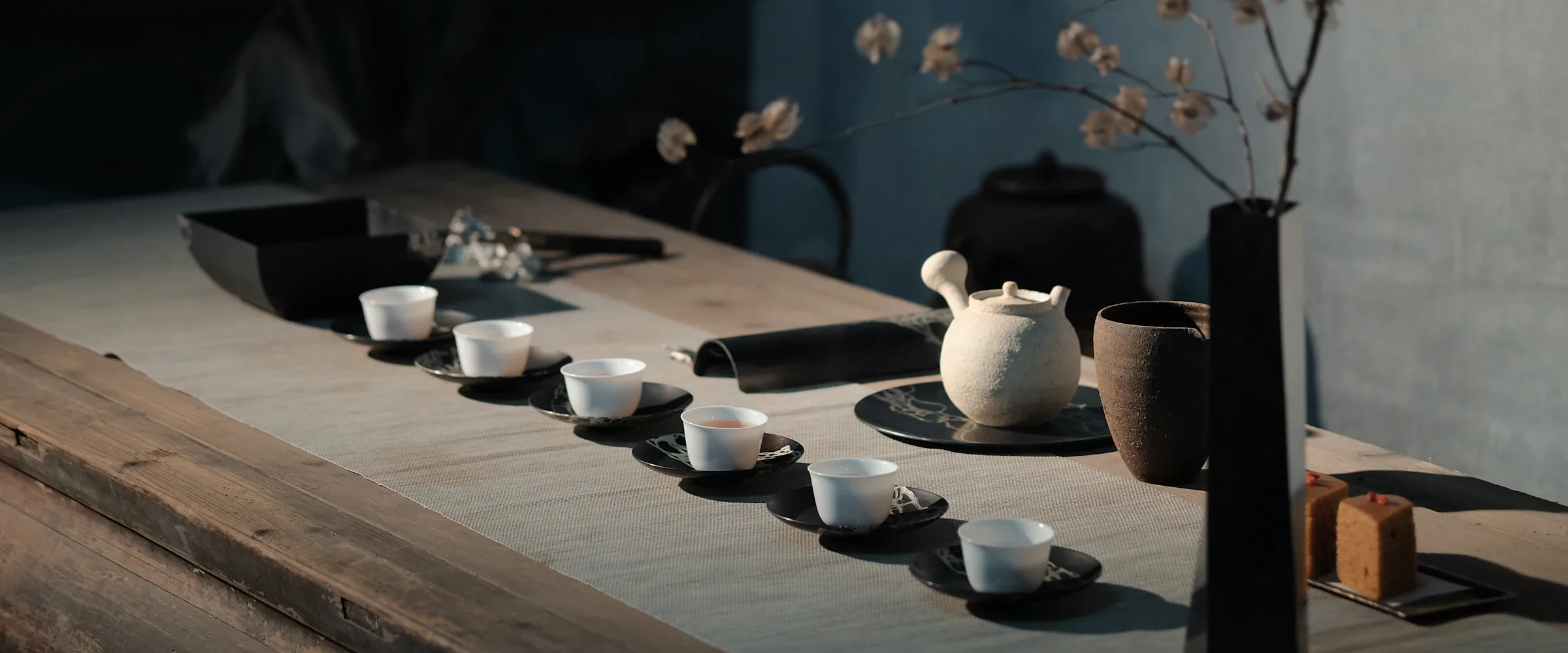
Puerh is where the house spends its attention. The cakes are sold two ways, as a 30 or 50 g slice or whole: a Princess Yiwu sheng from 2013, two 2025 shou cakes from Zhang Lang and Pasha in Xishuangbanna, and three spring 2025 Vietnamese cakes, two raw and one white, pressed from old trees near the Chinese border. The founders brew gong fu style and teach it at the tastings, and the catalogue reads the same way, with steep counts and picking standards rather than tasting superlatives. The teaware on the shelf is made by South African ceramicists.

 Tea shops · Johannesburg, South Africa