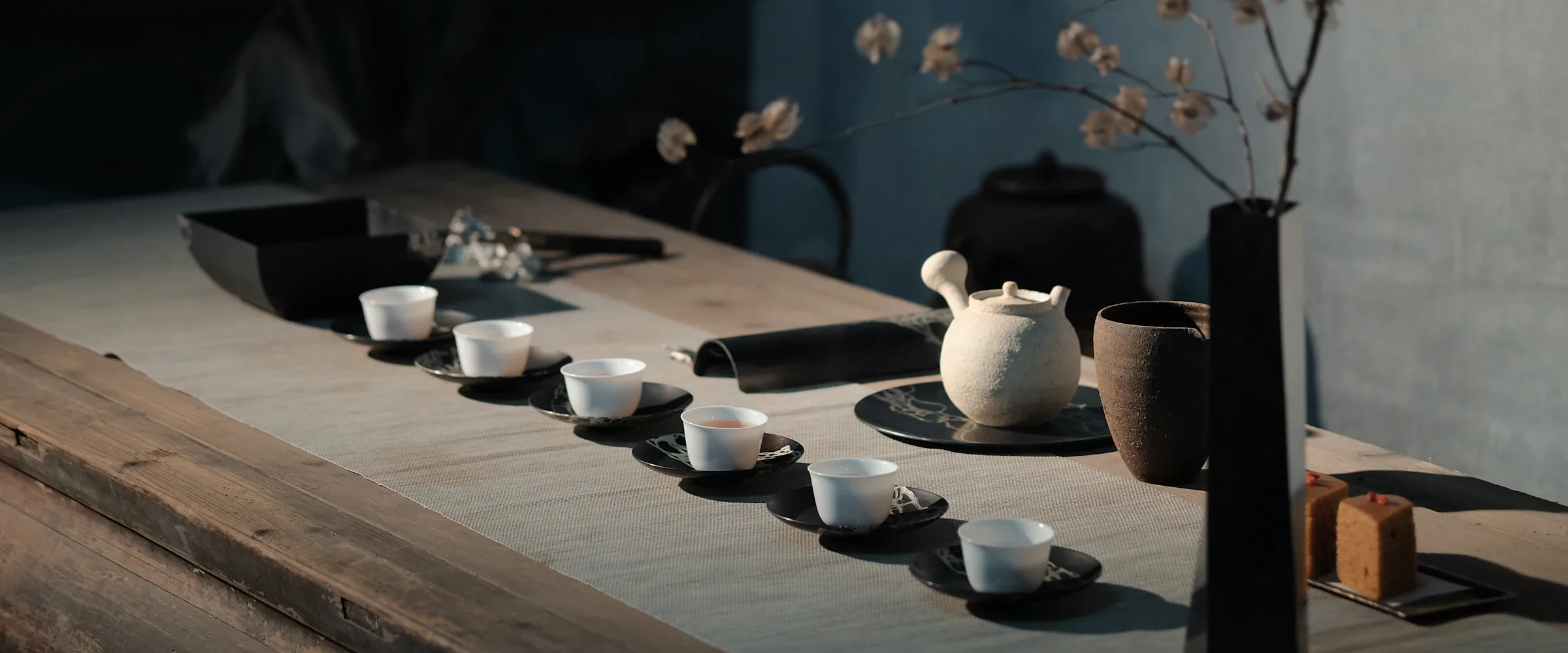
Masuhan began in 1840, when Hanzaburo, third son of the Masuya merchant family, decided that ground tea should not be a luxury reserved for the upper classes and went to Uji to buy it himself, opening the Shohakuen shop in the castle town; by the end of the Edo period the house was purveyor to the town magistrate. The second generation set up its own tea garden and factory at Kohata in Uji and won prizes at the national industrial exhibitions. The shop burned in the war and was rebuilt in 1951, and in 2023 the main shop at 2-7-1 Nishiki was renewed with a café and a tea room.
Matcha is the reason the house exists and it is still Uji tencha, ground on stone mills turned slowly so the friction never warms the powder, and only in the quantity the shop expects to sell, so what is on the counter is freshly milled. Ten grades go from Chiyo no Mukashi and Konomukashi through Hatsumukashi, Atomukashi and Gokumukashi to Akebono, in boxes and tins from 20 g up. The café serves the same matcha in a soft serve the shop has made since 1961, in a five-sweet plate, and brews Shoto, its top sencha, by the pot.
The leaf side follows the same Uji line: four senchas from Shokisen to Shoto, a cellar-aged Kuradashi sencha, four gyokuros from Ayataka to Zuiun, the straw-shaded Wara-kabuse, Wakayanagi bancha, Kiyoori stem tea, two fine teas for konacha, three genmaichas and two hojichas roasted light so the leaf's own sweetness stays, plus a sencha with black soybean, barley tea and salted cherry blossoms. Tea bags cover sencha, kabusecha, hojicha, roasted stems and genmaicha. Beyond the main shop there is a counter in the Mori no Chikagai mall at Sakae and others at Matsuzakaya Nagoya and Mitsukoshi Hoshigaoka.

 Tea shops · Nagoya, Japan